

Julian Brown has the internet staring at a luxury drop-top and a pile of trash a little differently this week.
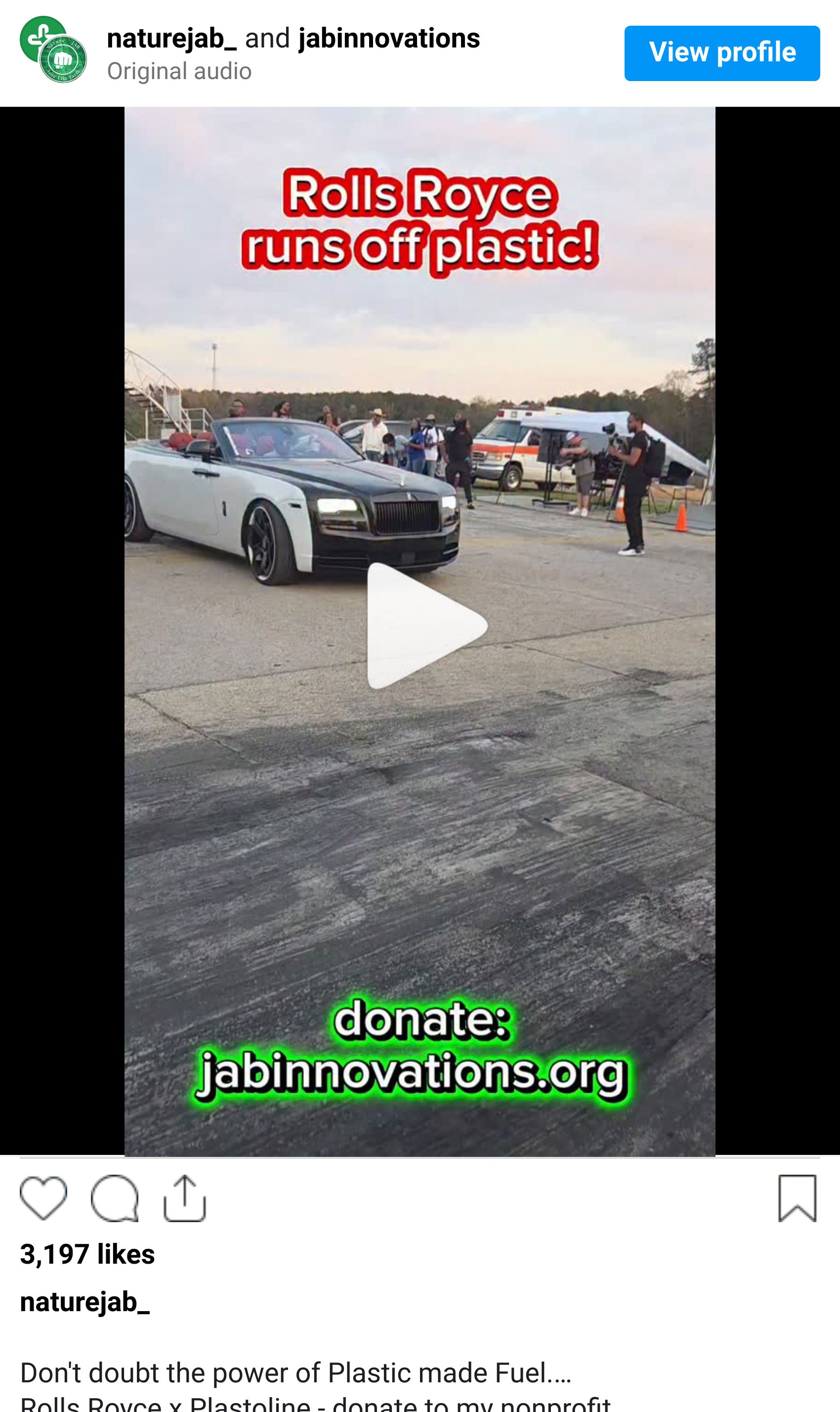
The Georgia inventor, better known online as @naturejab, went viral after footage from Huntsville, Alabama showed a Rolls-Royce being fueled with his plastic-derived oil, “Plastoline,” and then driving off without drama. Brown had been teasing the stunt in the lead-up, calling it a historic moment, and social clips from the March 21 demo quickly pushed the story across Instagram, Threads and local news pages. Brown later said the car was the first Rolls-Royce to operate on Plastoline, while reposted footage framed it even more bluntly: plastic waste went in, a luxury car moved out.
Brown has been building toward this for years through NatureJab, the project and company around his microwave pyrolysis work. He claims the system turns organic waste into fuel in the absence of oxygen and argues that using electricity means the reactor could potentially run on renewables. The site also frames the mission in bigger, almost manifesto-like terms: waste is not waste, but “untapped potential energy.” In a 2024 interview, Brown said plastic-to-fuel itself is not new, but that his focus is on pushing microwave pyrolysis toward more serious industrial and continuous-scale use.

Brown has spent the past year publicly escalating these tests, first drawing attention for running other vehicles on Plastoline and then hyping the Rolls-Royce event in advance. He has described Plastoline as a 110-octane fuel, and one recent report on the Alabama demonstration said Brown estimated that roughly 10 pounds of plastic can yield one gallon of fuel. He also admitted he was nervous during the Rolls test, especially when the car did not start immediately, which only makes the eventual drive-off feel more dramatic in hindsight.

Brown’s claims about the fuel’s performance and emissions have won huge attention online, but plastic-to-fuel through pyrolysis is not universally accepted as a clean fix for the plastics crisis. The U.S. EPA has acknowledged pyrolysis and gasification as processes used to convert waste feedstocks, including plastics, into fuels and other products. But critics argue that most so-called chemical recycling ends up producing fuels rather than true recycling outputs, and that these fuel products can carry pollution and health concerns of their own.
In other words, the Rolls-Royce moment may be very real and very impressive, but the larger question of whether this is a climate solution, a waste workaround or a flashy proof of concept is still very much up for debate.